

The short answer: an upstand is a short strip of stone fixed along the wall at the back of your worktop. A splashback is a taller panel that covers the wall behind the hob or sink. Many kitchens use both: a splashback where the cooking and washing happen, and a matching upstand along the rest of the run.
This guide explains the difference, gives a wall-by-wall guide to which one goes where, and lists what to mark on your plan before templating. To see finished work, browse our stone upstands and stone splashbacks and wall cladding. Still choosing the worktop itself? Start with our sintered stone vs granite vs quartz comparison.
The difference
Upstand or Splashback: What Sets Them Apart
The difference is height and purpose. An upstand sits on the worktop against the wall and rises only a short way, finishing the joint where stone meets plaster and protecting the paintwork just above it. A splashback carries on up the wall behind the hob, sink or range cooker, where splashes, steam and spatter reach higher.
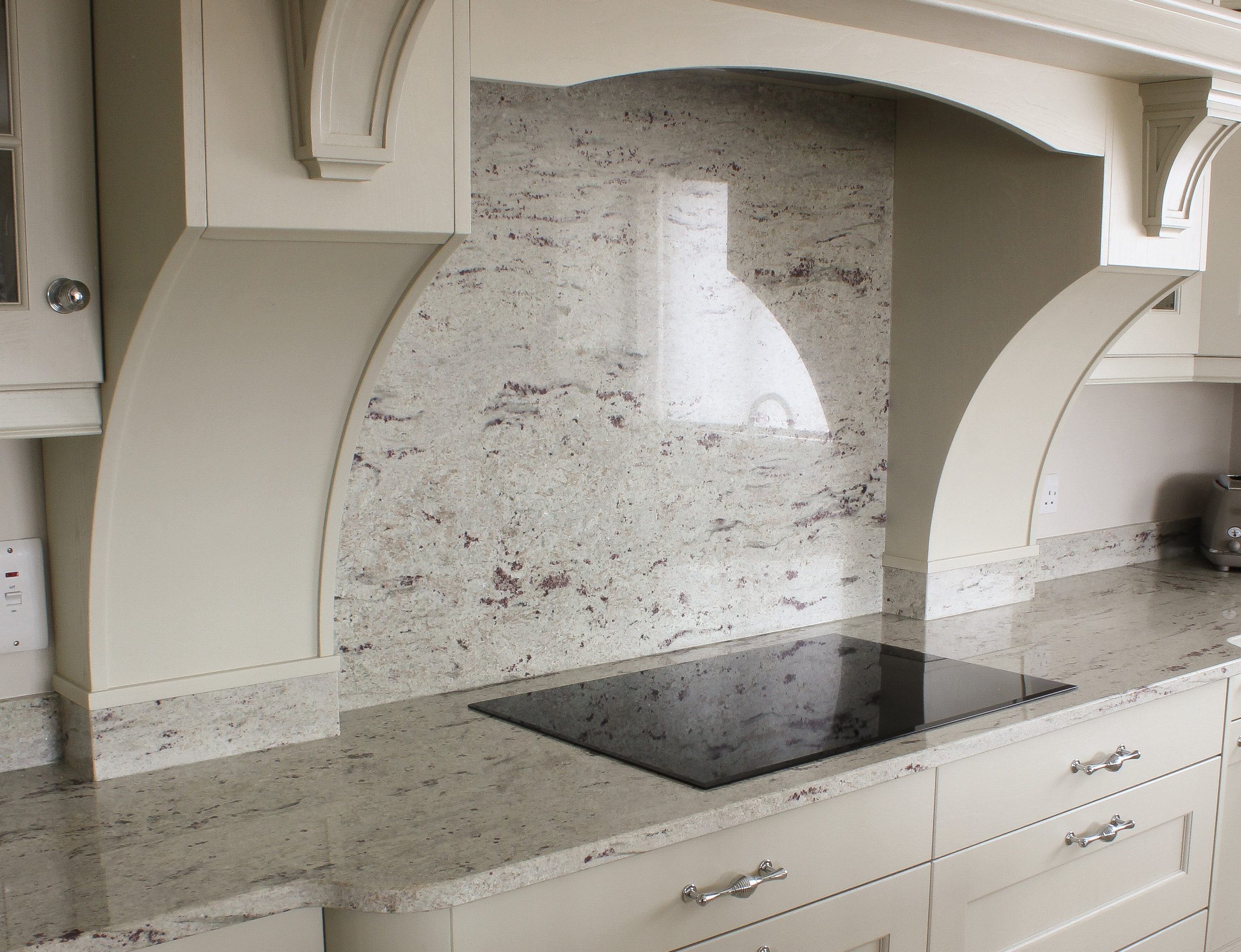
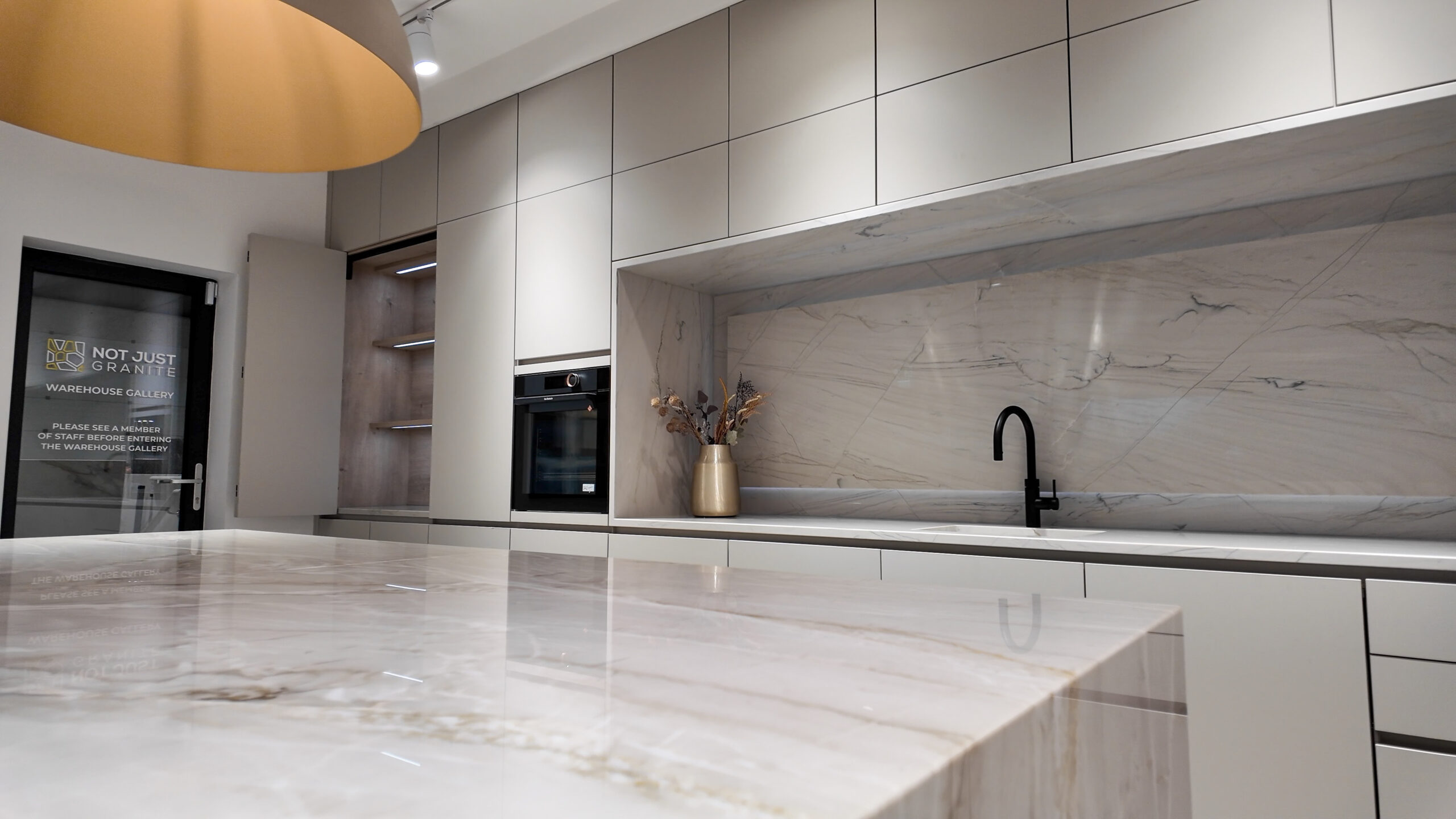
Both are cut from stone, usually the same stone as the worktop, so the kitchen reads as one continuous surface. In the kitchen pictured, a granite splashback fills the arch behind the hob while a low upstand in the same granite runs along the worktop on either side.
At a glance
- Upstand: a low strip along the back of the worktop, covering the wall joint
- Splashback: a taller panel behind the hob or sink, where splashes reach higher
- Wall cladding: stone taken further up the wall as a design feature
- All three can be cut from the same stone as your worktops
The upstand
What Is an Upstand?
An upstand is a narrow band of stone fixed to the wall along the back edge of the worktop. It covers the join between worktop and wall, so there is a clean, wipeable edge where crumbs and water would otherwise gather against paint, and it protects the wall just above the work surface.
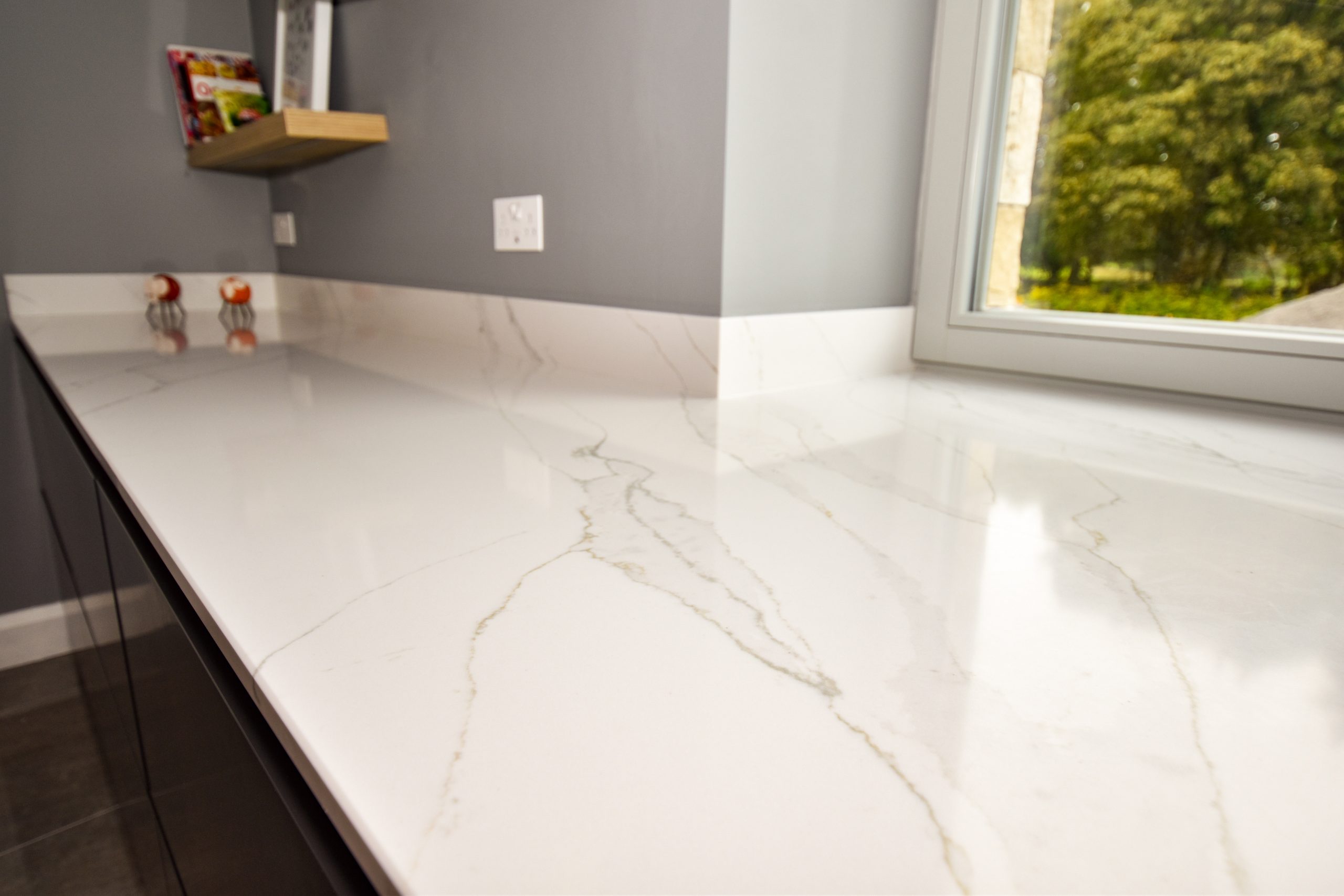
It follows the worktop along the wall and around corners. In the kitchen pictured, the upstand runs along the wall and returns into the window recess, so the stone frames the worktop without covering the wall. Because it is low, the wall colour above it stays on show. Upstands suit bathrooms as well as kitchens, finishing the wall behind a vanity top.
See finished examples on our made-to-measure stone upstands page, and matching sills on our stone window sills page.
Where an upstand works well
- Along worktop runs with no hob or sink behind them
- Under windows, alongside a stone window sill
- Where the wall above will be painted or tiled
- Kitchens with the hob and sink on the island, not the wall
The splashback
What Is a Splashback?
A splashback sits behind the hob or sink to protect the wall and cabinets from spills, splashes and stains, and it makes everyday cleaning quicker. Crafted from the same stone as the worktop, it looks as if the surface simply continues up the wall.
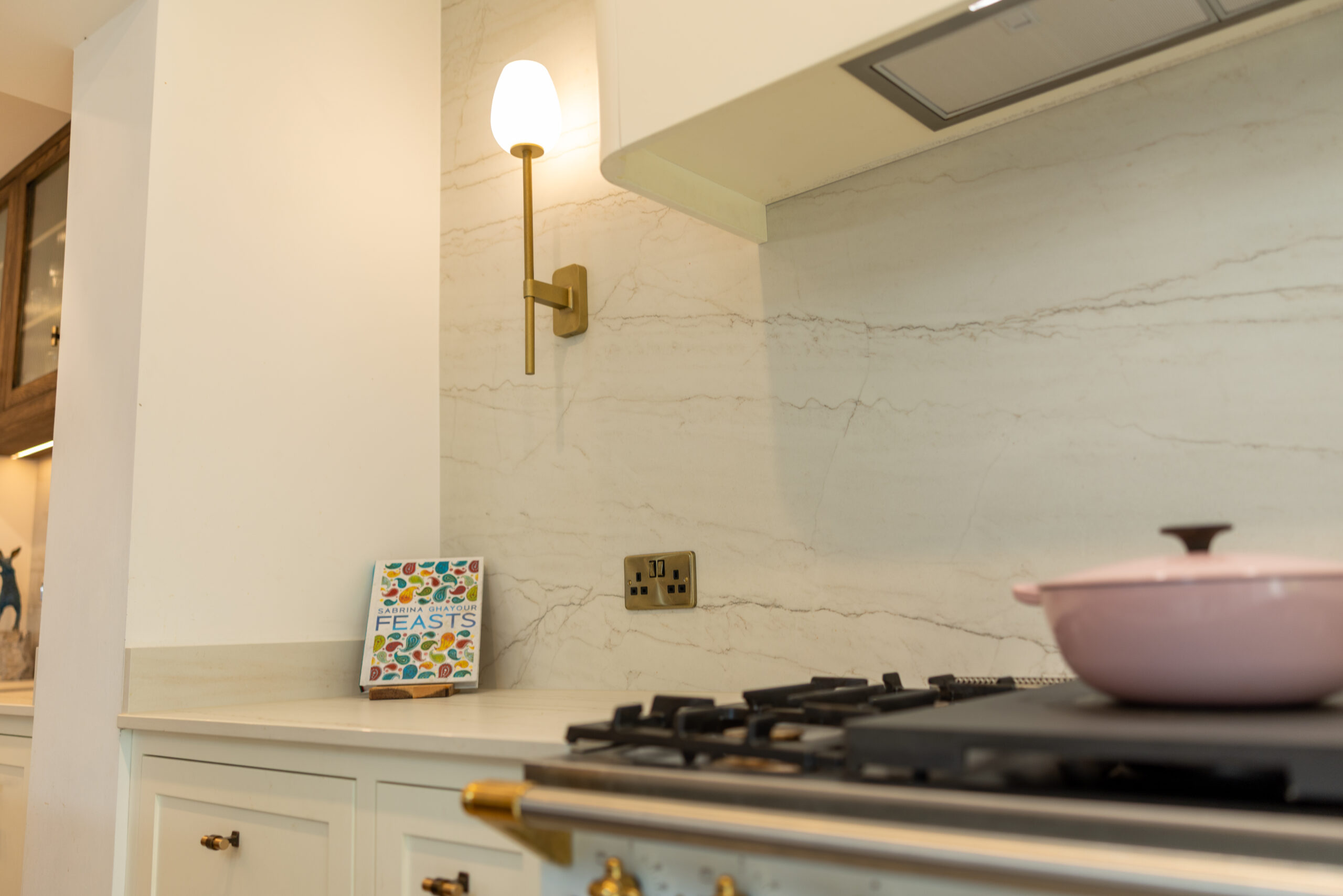
Splashbacks rise well above an upstand, often to the underside of the wall units or the extractor, as in the kitchen pictured, which is why they are the natural choice behind a range cooker or a hob against a wall.
Behind a hob, heat matters too. Granite is naturally heat resistant and sintered stone is extremely heat resistant, while quartz is less heat resistant than natural stone. Our material comparison sets out how the three differ.
Taken further up the wall, a splashback becomes wall cladding: a bold statement in a veined quartz, porcelain or marble, or a quieter finish matched to the worktop. See examples on our splashbacks and wall cladding page.
Where a splashback earns its place
- Behind a hob or range cooker, where spatter reaches above an upstand
- Behind a sink, where water splashes against the wall
- Anywhere you want the stone to be a feature, not a trim
Choosing
Which One Does Your Kitchen Need?
Most kitchens do not have to choose. A common approach is a splashback behind the hob or sink, where the splashes happen, and an upstand along the remaining runs, where it simply finishes the wall. Cutting both from the same stone keeps the kitchen consistent.
Moving the hob or sink onto an island changes the answer. The wall runs may then only need an upstand, or no stone at all if the wall behind is to be tiled. Our kitchen island guide covers that planning.
At the other end of the scale, a full-height splashback or cladding along a whole wall turns the stone into the focal point of the room. It is the most striking option, and the one that uses the most stone.
Wall by wall: upstand or splashback?
- Hob or range cooker against the wall: splashback behind it
- Sink against the wall: splashback behind it, or an upstand if the wall above is tiled
- Worktop runs with no hob or sink: upstand
- Under a window: upstand, finished with a stone window sill
- Hob and sink on the island: upstand on the wall runs, or no stone if the wall is tiled
- Stone as the feature of the room: full-height splashback or wall cladding
Planning the details
Sockets, Windows and Corners
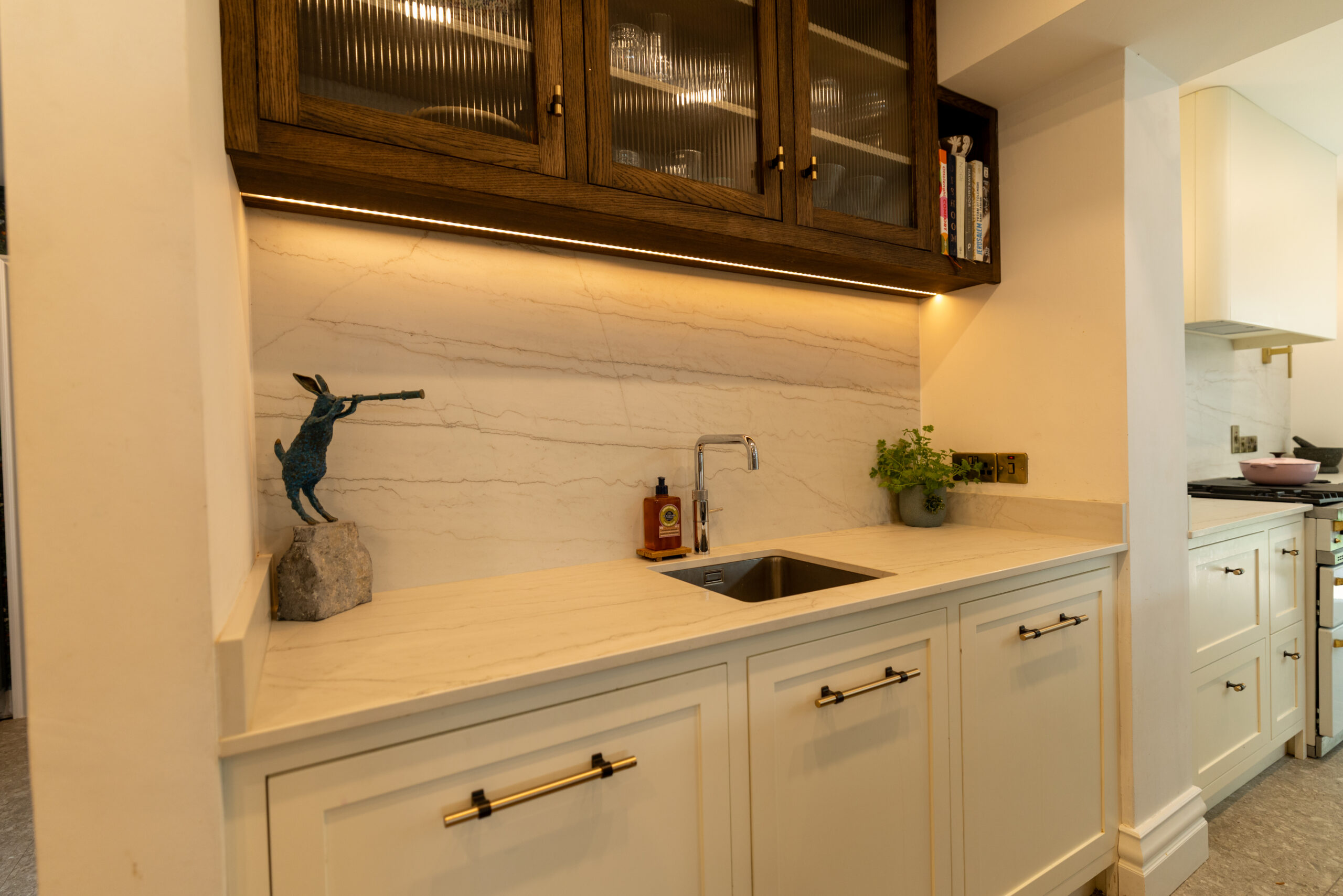
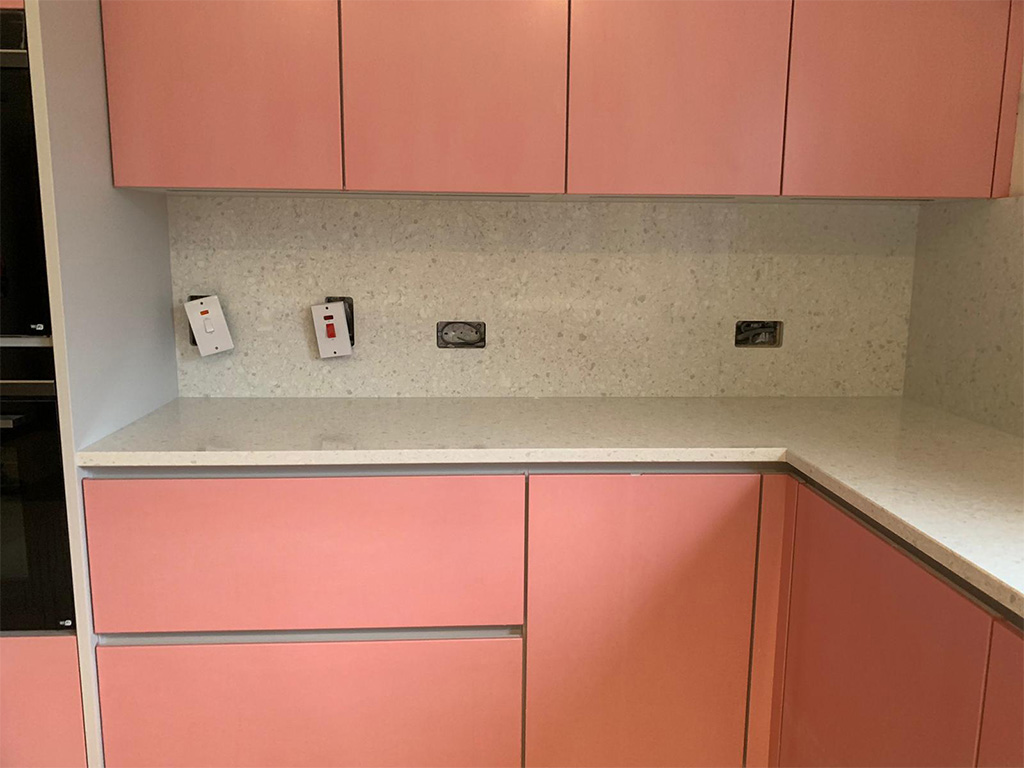
Stone on the wall has to work around what is already there. Sockets and switches in a splashback or cladding need precise cut-outs, so if cladding is going on, the sockets must be off the wall and made safe before we template. Your electrician then refits them once the stone is in.
Windows need the same forethought. An upstand can follow the wall into a window recess, and where cladding goes on, a stone window sill can be mitred or integrated with the cladding and the reveals. Deciding this at the planning stage means the pieces are templated together rather than patched later.
We recommend painting and tiling after the worktops are installed, not before. You can see how templating, fabrication and fitting work on our installation process page.
Ready for templating day
- Units and the extractor hood securely fixed and level
- Sinks, hobs and taps on site for the templater
- Sockets off the wall and made safe where cladding is going on
- Painting and tiling left until the stone is installed
Cost and matching
What They Add to a Quotation
Upstands and splashbacks are cut from the same slabs as your worktops, so they are quoted as part of the same job, with each one itemised. The more wall the stone covers, the more slab it uses: a full-height splashback uses far more stone than an upstand along the same run, and a tall upstand uses more than a standard one.
Beyond height and length, the figure moves with the detailing: socket cut-outs, mitres at windows and corners, and whether the splashback matches the worktop or is a contrasting feature slab. Each one adds material, machine time or both, which is why it is worth marking them on your plan from the start.
Our guide to what worktops cost in Ireland explains how a stone quotation is built and how to compare two of them properly.
Mark these on your plan
- Which walls get an upstand, and which get a splashback
- How high you want each splashback to go
- Every socket, switch and window reveal the stone will meet
- Same stone as the worktop, or a contrasting slab

Quick answers
Kitchen Upstands and Splashbacks: Your Questions
What is an upstand in a kitchen?
An upstand is a short strip of stone fixed to the wall along the back edge of the worktop. It covers the join between worktop and wall and protects the paintwork just above the work surface. It is usually cut from the same stone as the worktop, so the two read as one piece.
What is the difference between an upstand and a splashback?
Height and purpose. An upstand is low and runs along the worktop to finish the joint with the wall. A splashback is a taller panel behind the hob or sink, where splashes and cooking spatter reach higher up the wall. Many kitchens use both, cut from the same stone.
Can you have an upstand and a splashback in the same kitchen?
Yes, and it is a common combination: a splashback behind the hob or sink, and a matching upstand along the rest of the worktop run. Cutting both from the same stone as the worktop keeps the finish consistent around the room.
Do I need a splashback behind my hob?
If the hob or range cooker sits against a wall, a splashback is the usual choice, because cooking spatter reaches higher than an upstand covers. If the hob is on an island, there is no wall behind it, and the wall runs can take an upstand instead. Heat resistance differs between granite, quartz and sintered stone.
Does the upstand have to match the worktop?
No, but it usually does, because a matching upstand makes the worktop appear to turn up the wall. A contrasting splashback or wall cladding in a veined quartz, porcelain or marble can be used as a feature instead. Our Galway showroom has wall-mounted samples to compare, and samples to take away.
Finish your kitchen on notjustgranite.ie
Not Just Granite · Galway, Ireland
Plan the walls
with your worktops
Send us your kitchen plan or a sketch with the dimensions, mark which walls you want finished in stone, and we will price the upstands, splashbacks and worktops together on one itemised quotation. Or see the options in our showroom in New Inn, Co Galway, Monday to Friday by appointment: call 09096 47926. Family-run stone specialists since 2003.
Request a quotation ↗