

The short answer: natural marble gives a kitchen veining that no other slab will repeat, and it asks for a little more care than quartz, porcelain or sintered stone. If you love the character and are happy to wipe up spills, it is a beautiful choice. If you want the look with less to think about, marble-look surfaces come close.
This guide covers what marble is like to live with, how to read the names, how to choose between the real stone and a look-alike, and how to pick a slab. To see what we work with, browse our stone collections. Still deciding on the material itself? Start with our sintered stone vs granite vs quartz comparison.
The material
What Marble Brings to a Kitchen
Marble is a natural stone, and its character is in the stone itself. The veining runs through the whole slab, so the pattern across the top of an island can carry over the edge and down a waterfall end. No two slabs match, which is the point: your kitchen ends up with a surface that nobody else has.
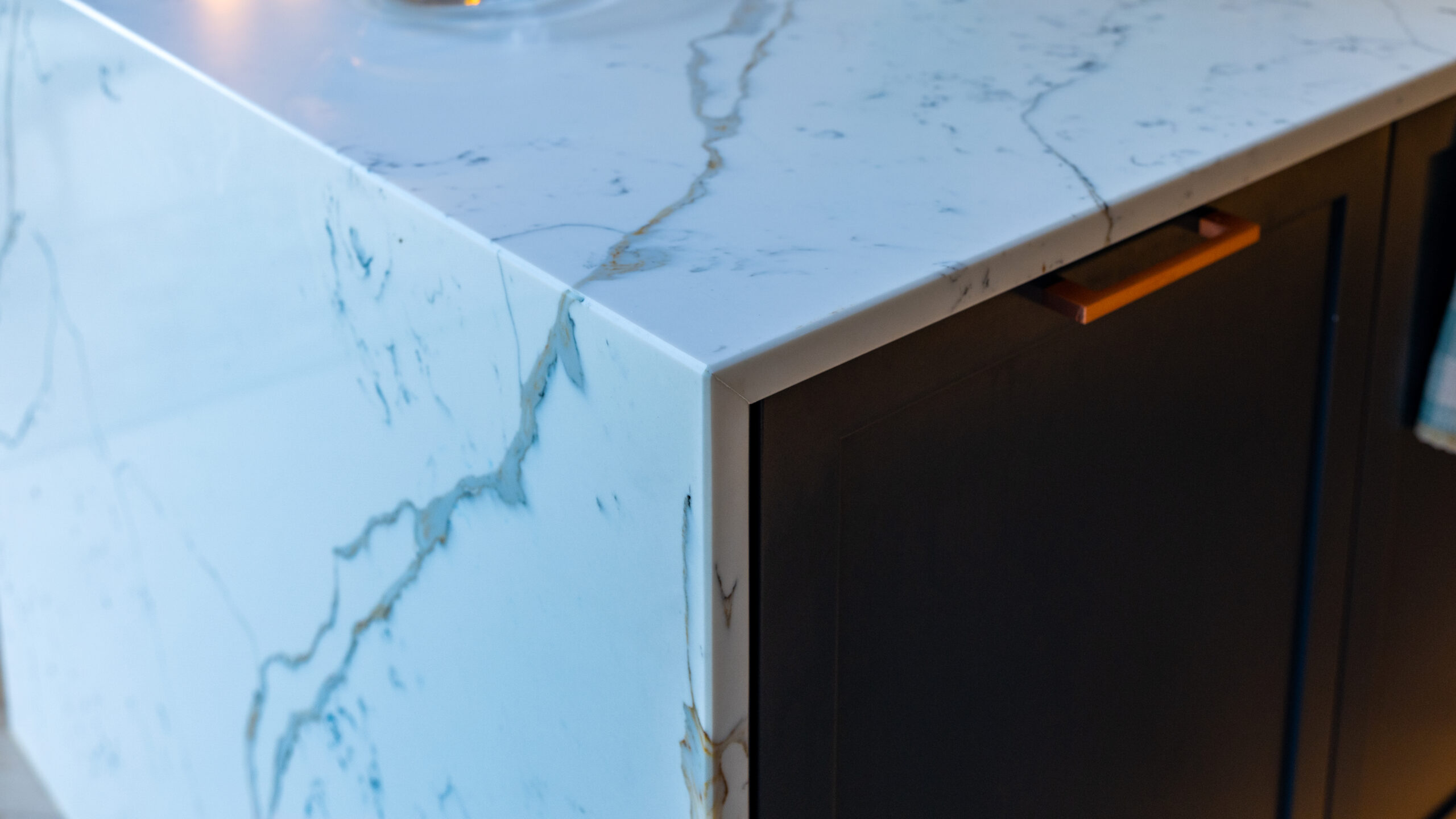
In the kitchen pictured, grey, blue and warm gold veining crosses the island and wraps the corner into the waterfall end. Whether a surface is natural marble or a marble-look stone, this sense of movement is what draws people to the look, and many owners find marble has a depth that a flat pattern struggles to copy.
It suits islands and feature runs best, where the veining is on show. See finished kitchens on our projects page.
Why people choose it
- Veining that is unique to your slab
- A pattern that can run over an edge into a waterfall end
- A classic look that suits traditional and contemporary kitchens
- Best on islands and feature runs, where it will be seen

The looks
Carrara, Calacatta and Statuario
These three names describe the look of a marble, and you will hear them in any showroom. Carrara is the softer one: a white to pale grey ground with fine, feathery grey veining. Calacatta is brighter and bolder, with a whiter background and dramatic veins that are often warm gold or brown. Statuario sits between them, with a bright white ground and strong grey veining.
The same names are used for marble-look quartz and porcelain, such as Calacatta Supreme and Carrara Gold. When a name sounds familiar, ask what the slab is made from. The name tells you the look, not the material.
In the close-up pictured, one broad band of gold and brown veining crosses the surface with finer grey lines around it, the kind of movement the Calacatta look is known for.
Reading the names
- Carrara: white to pale grey, with soft, fine veins
- Calacatta: brighter white, with bold, often gold-toned veins
- Statuario: bright white, with strong grey veins
- Always ask whether a slab is natural marble or a marble-look stone

Living with it
Living With Marble Day to Day
Natural marble is porous. That means it can stain, so spills such as oil, wine and coffee should be wiped up straight away. It also reacts to acids: lemon, vinegar and some cleaning products can dull the surface, which shows up as etching.
In practice this comes down to habits rather than hard work. Use a chopping board, wipe spills as they happen, and clean with a specialist marble cleaner or a mild surface spray, as set out in our stone care guide. Natural stone is sealed to protect it, and the same guide explains how it is resealed over time.
Some owners enjoy the way marble develops a soft, lived-in character. If you would rather the surface stayed exactly as it was installed, a marble-look quartz or porcelain may suit you better.
A simple routine
- Wipe spills straight away, especially oil, wine and coffee
- Keep lemon, vinegar and acidic cleaners off the surface
- Use a chopping board and never cut directly on the stone
- Clean with a specialist marble cleaner or a mild surface spray

Real or look-alike
Real Marble or a Look-Alike?
You do not have to choose natural stone to get the look. Marble-look surfaces come in quartz, porcelain and sintered stone, and all three are made to carry bold veining. You will find marble-look options in our collections.
Quartz is non-porous, so it needs no sealing and is easy to live with, though it is less heat resistant than natural stone. Porcelain is heat, stain and scratch resistant, and sintered stone is extremely heat resistant. Heat matters most behind a hob, as we explain in our upstands vs splashbacks guide.
Natural marble earns its place where you want a one-off slab and accept the care that comes with it. Our material comparison sets out how the other surfaces differ, and you can see them side by side in our showroom.
Which suits your kitchen?
- Natural marble: a statement island or feature run, and you are happy to wipe up spills
- Marble-look quartz: a busy family kitchen where you want no sealing
- Marble-look porcelain or sintered stone: heavy cooking and hot pans near the surface
- Not sure? See the slabs side by side before you decide

Finish and edges
Polished, Honed and the Edge
Marble can be finished polished or honed. A polished surface is glossy and reflective, and it deepens the colour and shows off the veining. A honed surface is matt and softer to the eye. Etching shows more readily on polished stone, which is worth knowing if you cook a lot.
Then the edge. A square edge keeps the look crisp, softer profiles round it off, and on an island a waterfall end lets the veining run all the way to the floor, as in the corner pictured. Our edge profiles page shows the options, and our waterfall end panels page shows how an island is finished.
Because the veining changes across a slab, ask where the joins will fall before the stone is cut. It is a small question that makes a visible difference.
Settle these early
- Polished or honed?
- Which edge profile suits the kitchen?
- Waterfall ends on the island, or a standard end?
- Where will the joins fall in the veining?
Choosing your slab
See the Slab Before You Decide
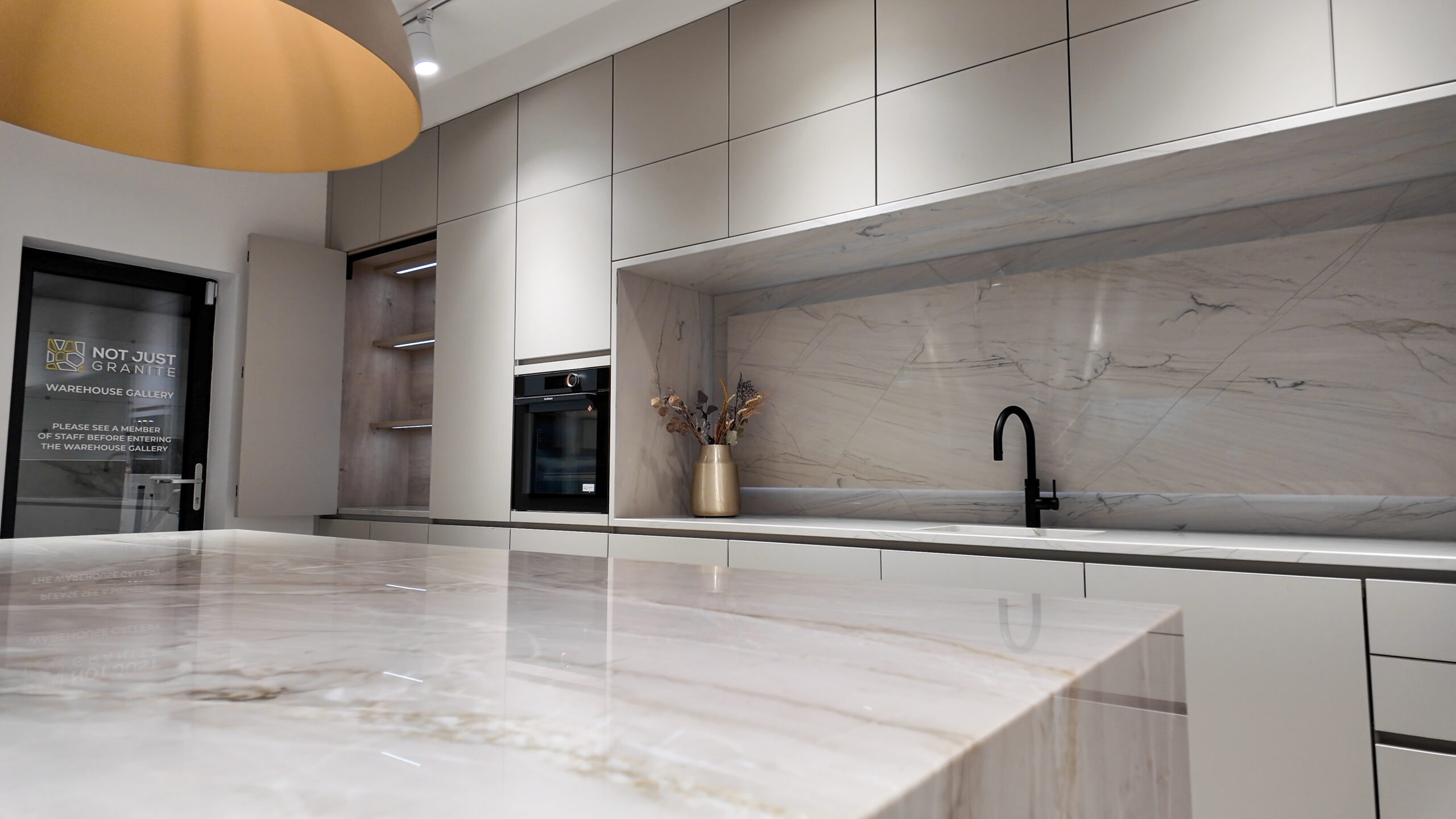
Veining changes from slab to slab, so a photograph can only take you so far. Our showroom in New Inn, Co Galway has wall-mounted samples of quartz, granite, sintered stone and marble, so you can compare them against your own cabinet colour and flooring.
Once you have chosen, a digital templater measures your units after they are fixed in place, so each worktop is made to your exact specification. It is fabricated at our factory in New Inn and fitted by our own team, for kitchens across Ireland. Our installation process page walks through each step.
Marble is quoted like any other stone. The slab you choose, how many slabs the job needs, the edge profile, cut-outs and waterfall ends all move the figure. Our guide to what worktops cost in Ireland explains how to compare two quotations like for like.
Bring to the showroom
- Your kitchen plan or a sketch with the dimensions
- A photo of your cabinet colour and flooring
- The sink, hob and tap you plan to use
- Any marble you have seen and liked

Quick answers
Marble in the Kitchen: Your Questions
Are marble worktops a good choice for a kitchen?
Yes, if you love natural veining and are happy to look after it. Marble is a porous natural stone, so spills need wiping up and acidic foods and cleaners should be kept off it. For a busy family kitchen or heavy cooking, a marble-look quartz, porcelain or sintered stone gives a similar appearance with less to think about.
Does marble stain or scratch easily?
Natural marble is porous and can stain if spills are left, and acids such as lemon or vinegar can dull the surface. A chopping board protects it from knife marks and etching. Clean with a specialist marble cleaner or a mild surface spray, and wipe spills up straight away.
What is the difference between Carrara and Calacatta?
Carrara has a white to pale grey ground with soft, fine grey veining. Calacatta is brighter and bolder, with a whiter background and dramatic veins that are often gold or brown. Both names are also used for marble-look quartz and porcelain, so ask what the slab is made from.
Is marble-look quartz the same as marble?
No. Marble is a natural stone. Marble-look quartz is an engineered surface made to carry marble-style veining. It is non-porous, so it needs no sealing, but it is less heat resistant than natural stone. Porcelain and sintered stone are other marble-look options and are extremely heat resistant.
Where can I see marble samples in Ireland?
Our showroom in New Inn, Co Galway has wall-mounted samples of quartz, granite, sintered stone and marble, open Monday to Friday by appointment. Call 09096 47926 or send us your kitchen plan and we will talk you through the options.
Plan your worktops on notjustgranite.ie
Not Just Granite · Galway, Ireland
See the stone
before you choose it
Send us your kitchen plan or a sketch with the dimensions, and we will talk you through marble and marble-look options and price your worktops on one itemised quotation. Or see the slabs in our showroom in New Inn, Co Galway, Monday to Friday by appointment: call 09096 47926. Family-run stone specialists since 2003.
Request a quotation ↗